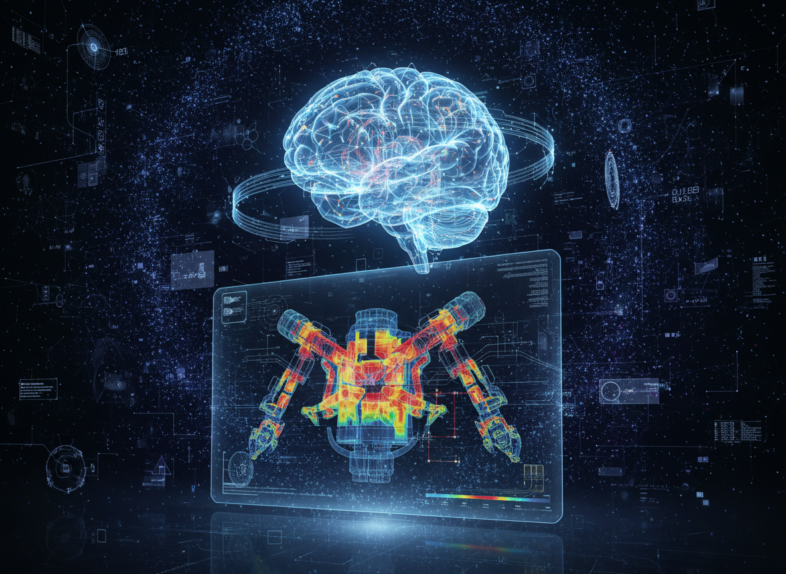
The focus on thermal profiles is a critical concern for AI development, primarily for two interconnected reasons:
-
As a Critical Engineering Constraint for AI Hardware
-
As a Powerful Application Domain for AI Itself
Let’s break these down.
1. Thermal Profiles as a Constraint: Keeping the AI Engines Running
The most advanced AI (like large language models and generative AI) requires immense computational power from hardware like GPUs and specialized AI accelerators (TPUs, NPUs). When these chips work at peak performance, they generate enormous amounts of heat.
-
Performance & Throttling: If this heat isn’t managed, the chip hits its thermal limit and engages in thermal throttling—it automatically slows down to prevent damage. For AI training, which can take weeks or months, this means wasted time, energy, and money. Focusing on thermal profiles allows engineers to design cooling systems that keep the hardware running at its maximum, most efficient speed.
-
Reliability & Longevity: Excessive heat is the primary enemy of electronic components. Sustained high temperatures drastically shorten the lifespan of extremely expensive AI servers. Managing thermal profiles is essential for data center uptime and return on investment.
-
Energy Efficiency & Cost: Cooling is one of the largest operational expenses for data centers. A significant portion of the total electricity used by an AI data center goes not to computing, but to removing the heat generated by that computing. Optimizing thermal management directly reduces the carbon footprint and operational cost of AI.
In short: To push the boundaries of AI capability, we must first solve the fundamental physical problem of the heat its hardware generates. This is why companies invest heavily in advanced cooling (liquid cooling, immersion cooling) and use AI itself to dynamically manage data center cooling systems.
2. Thermal Profiles as an Application: AI Analyzing the World’s Heat Signature
Here, “thermal profiles” are the data input for AI. AI, particularly computer vision models, is exceptionally good at analyzing thermal imaging data from infrared cameras.
-
Predictive Maintenance: AI can spot anomalous hotspots in industrial machinery, electrical substations, or solar farms long before a catastrophic failure occurs.
-
Medicine & Healthcare: From mass fever screening to identifying circulatory issues (like diabetic foot ulcers) or even aiding in certain cancer detections.
-
Building Efficiency: Identifying heat leaks in buildings for insulation upgrades.
-
Autonomous Vehicles & Security: Enhancing perception systems for night driving, fog, or smoke where visible-light cameras fail. Used in surveillance and search-and-rescue.
-
Agriculture: Monitoring crop health for water stress or detecting livestock illness.
In this domain, AI is the tool that interprets thermal data to solve real-world problems.
Why the “Focus” is So Intense Now: A Perfect Storm
-
The Rise of Giant Models: Modern AI models have grown exponentially in size (parameter count), demanding more powerful, denser hardware that generates more heat per square centimeter than ever before.
-
The Wall of Energy Consumption: The industry has hit a practical limit on how much power a single chip rack can consume and cool with traditional air cooling. Thermal management is now the primary bottleneck for scaling up computing power.
-
AI-Optimizing-AI: We’ve entered a cycle where:
-
AI needs more powerful, hotter hardware.
-
We use AI to design more efficient chip architectures (a field called AI for EDA).
-
We use AI to optimize the real-time cooling of the data centers that train AI.
-
Conclusion: The focus on thermal profiles is not a side project; it is central to the sustainable advancement of AI. It is both the critical physical limitation that must be overcome and a rich source of data that AI can master. Without breakthroughs in thermal management, the progress of AI itself would grind to a halt.