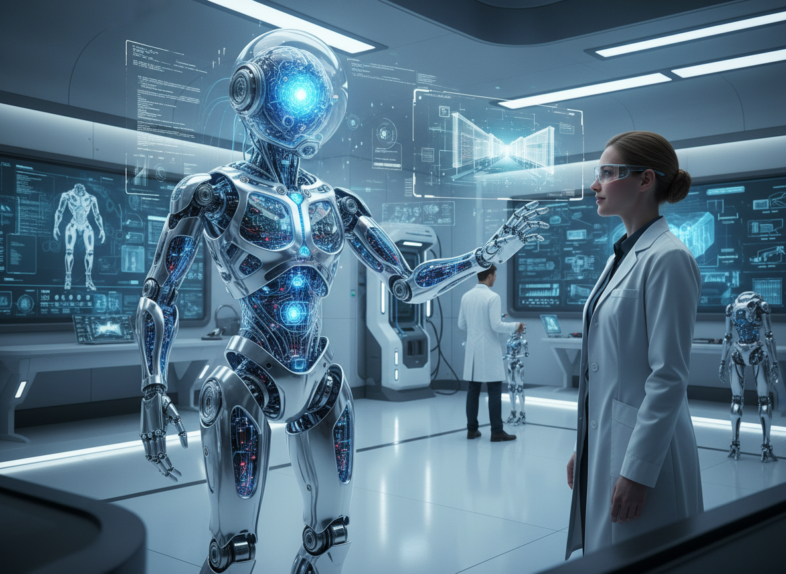
Absolutely, yes. The development of future robots is not just using AI—it’s becoming inseparable from AI. We are moving beyond robots as simple pre-programmed machines toward AI-embodied agents that can perceive, learn, and act in complex, unstructured environments.
Here’s a breakdown of how AI will be fundamentally integrated:
1. The “Brain” of the Robot: From Scripts to Intelligence
-
Traditional Robotics: Relied on precise, hand-coded instructions for every possible scenario. This fails in dynamic, real-world settings (like a cluttered home or a busy sidewalk).
-
AI-Powered Robotics: AI (especially machine learning, computer vision, and reinforcement learning) provides the cognitive layer. Robots will:
-
Perceive their environment in real-time using cameras and sensors, interpreting scenes with CV models.
-
Learn from demonstration or trial-and-error (simulated or real) how to perform tasks.
-
Plan and make decisions on the fly, adapting to new situations.
-
2. Key AI Technologies Driving This Fusion
-
Simulation & Digital Twins: AI models are trained for thousands of years’ worth of experience in realistic virtual environments (using tools like NVIDIA’s Isaac Sim) before transferring skills to physical robots. This is the only scalable way to learn.
-
Large Language Models (LLMs) & Multimodal AI: These allow robots to:
-
Understand complex, natural-language instructions (“Please tidy up the living room and put the misplaced books on the shelf”).
-
Reason about tasks step-by-step (chain-of-thought reasoning).
-
Ground language in physical actions and visual scenes.
-
-
Embodied AI: A dedicated research field where AI “agents” learn to inhabit and interact with a physical or simulated body. The goal is to develop common sense and physical intuition.
-
Self-Supervised & Reinforcement Learning: Robots will continuously learn and improve from their own interactions, reducing the need for massive, labeled datasets.
3. The Paradigm Shift: General-Purpose vs. Single-Purpose
-
Past: Robots were designed for one repetitive task in a controlled setting (e.g., welding car frames).
-
Future (AI-Driven): The goal is general-purpose robots that can perform a vast array of tasks in diverse environments—from folding laundry to assisting in surgery to repairing infrastructure. AI is the key to this flexibility.
4. Practical Examples Already in Development
-
Tesla Optimus, Figure AI, Boston Dynamics (with AI integration): These humanoids are explicitly designed to be platforms for advanced AI “brains.”
-
Warehouse & Logistics Robots (from Amazon, Boston Dynamics): They use AI for navigation, object recognition, and manipulation in semi-structured spaces.
-
Surgical Robots (e.g., from Intuitive Surgical): Increasingly incorporating AI for enhanced precision, tissue recognition, and surgeon assistance.
5. The Major Challenges Being Tackled
-
The Sim-to-Real Gap: Bridging the difference between flawless simulation and messy reality.
-
Safety & Reliability: Ensuring an AI-driven robot acts safely and predictably around humans—a monumental challenge in ethics and control theory.
-
Hardware-Software Co-design: Creating robot bodies (actuators, sensors, materials) that are as adaptable and responsive as the AI software controlling them.
Conclusion: A Symbiotic Future
Future robots will be AI embodied. AI will handle the high-level reasoning, perception, and adaptation, while the robot’s body will provide the physical interface to the world. The development process itself will be AI-driven, with algorithms designing parts, optimizing movements, and training control policies.
Therefore, the question isn’t if future robots will be developed using AI, but rather to what degree AI will define their every capability. The trajectory is clear: Robotics is becoming an applied branch of advanced AI.