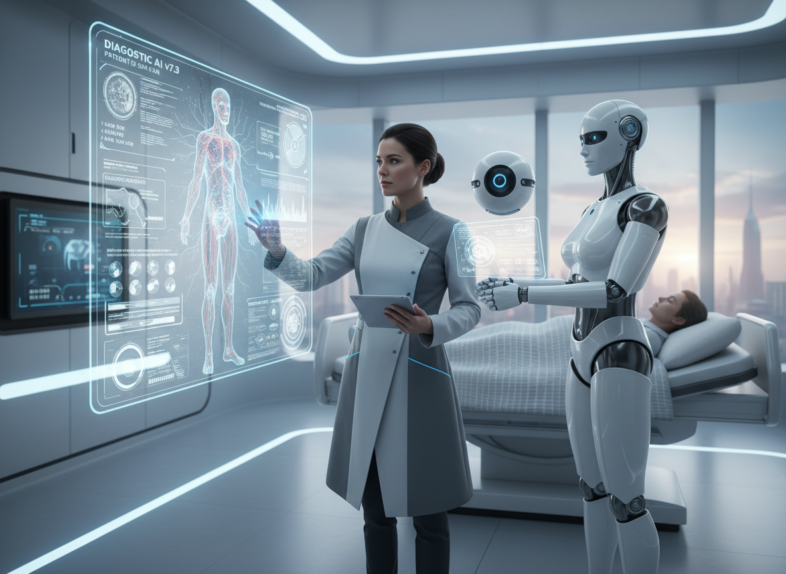
The short answer is neither, but with a massive asterisk. The role of “doctor” will evolve significantly, shifting from being the sole repository of medical knowledge to becoming a hybrid expert who integrates advanced technological tools into patient care.
Here’s a breakdown of what this means and why the simplistic “doctor vs. developer” dichotomy is misleading:
The Core Role of the Doctor Will Remain, But Transform
The fundamental duties of a doctor—diagnosis, treatment planning, empathetic communication, and ethical responsibility for a patient’s well-being—will remain irreplaceably human. However, the tools and knowledge base they use will be deeply technological.
Future doctors will need to be:
-
Expert Integrators & Translators: They will act as the crucial bridge between complex AI outputs/engineering solutions and the unique human context of a patient. They won’t code the algorithm, but they must understand its limitations, biases, and clinical relevance enough to interpret its recommendations.
-
Data-Literate Clinicians: They will be fluent in reading and questioning data dashboards, genetic risk profiles, and continuous biomarker streams from wearable devices. Understanding probability, statistics, and data visualization will be as fundamental as reading an X-ray is today.
-
Managers of Human-AI Teams: Their role will involve supervising and validating the work of AI diagnostic assistants, robotic surgical systems, and automated monitoring tools. The “final call” and human judgment will still rest with them.
Where Developers & Engineers Come In: The Supporting Ecosystem
The medical field will become a deeply collaborative triangle:
-
Doctors (Clinical Experts): Define the clinical problem, provide domain expertise, and use the tools at the bedside.
-
Developers & AI/Software Engineers: Build the tools—the diagnostic algorithms, the hospital management software, the interfaces for electronic health records, and the apps for patient engagement.
-
Biomedical & Robotics Engineers: Build the hardware—the next-generation surgical robots, advanced prosthetics, implantable sensors, and novel imaging devices.
Crucially, there will be a new, hybrid role emerging at the intersection:
The Rise of the “Physician-Engineer” or “Clinical Informaticist”
This is where your question hits the mark. We will see more professionals with dual training:
-
MD/Ph.D. in Biomedical Engineering or Computer Science: Individuals who can both practice medicine and contribute directly to building the technology.
-
Clinical Informaticists: A recognized medical specialty focused on optimizing the use of information and technology in healthcare. They are doctors who speak the language of both medicine and IT.
Analogy: Pilots and Aviation
A modern airline pilot is not an aeronautical engineer who built the plane, nor a software developer who coded the fly-by-wire system. However, they have a deep operational understanding of these systems, know their limits, and are trained to manage them, especially when automation fails. The pilot’s core skill—safely navigating from A to B—is augmented by, not replaced by, technology. The future doctor will be similar.
Conclusion: A Collaborative, Tech-Enhanced Future
Doctors will not become primarily developers or engineers. Instead:
-
The profession of medicine will require a strong “tech quotient”—literacy in data, algorithms, and devices.
-
The healthcare system as a whole will be built and maintained by deep collaboration between clinicians, developers, and engineers.
-
Hybrid roles (Physician-Engineers) will be the vital innovators and bridge-builders, but they will remain a subset of the medical field.
The human elements of trust, empathy, ethical judgment, and holistic care cannot be coded. The doctor of the future will leverage engineering marvels and developer-built AI to augment these irreplaceable human skills, not replace them.